European Architectural Photography: Geometry, Symmetry & Light
From ancient Roman barrel vaults to Santiago Calatrava's bio-morphic concrete and Frank Gehry's titanium curves.
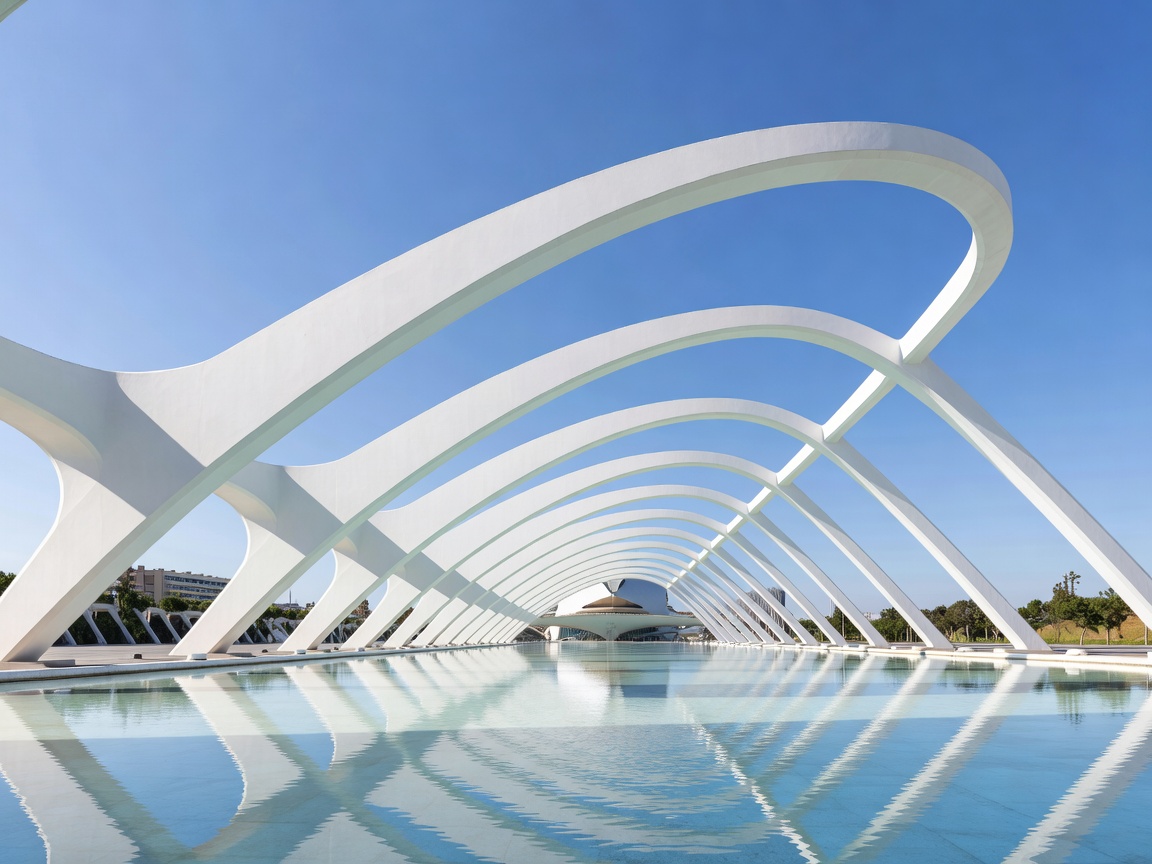
1. Santiago Calatrava’s City of Arts and Sciences (Valencia, Spain)
The Ciudad de las Artes y las Ciencias (39.4539° N, 0.3533° W) along the dry Turia riverbed in Valencia represents the pinnacle of modern bio-morphic architecture in southern Europe. The structural white concrete ribs resemble skeletal whale spines, surrounded by expansive shallow turquoise reflecting pools.
- Symmetry Calibration: Position your tripod exactly along the central axis of the Hemisfèric building. By lowering camera elevation to 15cm above the water surface, you create a mirror-reflection illusion completing the "eye" geometry.
- Monochrome Conversion: The pure white concrete against deep blue Mediterranean skies makes this complex one of the finest black-and-white architectural subjects in the world.
- Recommended Optics: 12-24mm or 14-24mm ultra-wide lens. At night, prolonged 20-second exposures at f/11 blur pool water ripples into glass reflections while lighting up the neon arcs.
2. Frank Gehry’s Guggenheim Museum (Bilbao, Spain)
Clad in 33,000 micro-thin titanium panels that flex with thermal expansion, the Bilbao Guggenheim (43.2686° N, 2.9340° W) reacts dynamically to atmospheric conditions. Under overcast skies, the titanium takes on a matte platinum tone; during sunset, it turns into liquid amber gold.
When pointing standard wide lenses upward at high buildings, vertical parallel lines converge inward (keystoning). Use a Tilt-Shift Lens (e.g. 24mm or 19mm TS-E) to physically shift the optical element upwards while keeping the camera sensor perfectly vertical to the ground plane, retaining pure 90-degree lines without computational cropping.
3. Classical Roman Symmetry: The Pantheon & Colosseum (Rome, Italy)
Photographing classical antiquities in Rome (41.8902° N, 12.4922° E) requires precise control over lighting angles. The Roman Pantheon’s 9-meter open oculus acts as an astronomical solar spotlight. Between 11:30 AM and 1:30 PM, a circular beam of natural sunlight tracks across the ancient gilded marble niches.
- Colosseum Arches: Scout the upper ring along Via Nicola Salvi at dusk. Frame passing vintage trams or modern traffic light trails through the ground-floor travertine arches to contrast antiquity with modern velocity.
- Travertine Texture & Highlights: Utilize a Circular Polarizer to remove harsh glare from ancient polished marble surfaces and bring out aged golden-ochre textures.
4. Haussmann Facades & Zinc Rooflines (Paris, France)
Under Baron Georges-Eugène Haussmann's 19th-century transformation of Paris (48.8566° N, 2.3522° E), streets were designed with strict proportional height ratios (usually 20 meters), cut-stone Lutetian limestone facades, continuous second and fifth-floor cast-iron balconies, and 45-degree sloping zinc mansard roofs.
- Street Geometry Vantage: Position yourself at wedge-shaped corner street intersections (such as Rue de Rivoli, Place de l'Opéra, and Avenue de l'Opéra). The triangular "flat-iron" Haussmannian corner buildings create pristine leading lines slicing through the composition.
- Overcast Sky Diffusion: Paris is famously suited for overcast diffused lighting. Gray Parisian cloud layers function as a gigantic softbox, preventing deep balcony shadow lines and revealing intricate stone friezes.
- Optics & Perspective: 50mm to 85mm prime lens for compressing balcony rhythm, or 24mm Tilt-Shift to capture the full five-story elevation from narrow cobblestone sidewalks.