Lofoten Arctic Winter: Dramatic Fjords, Rorbuer & Aurora Borealis
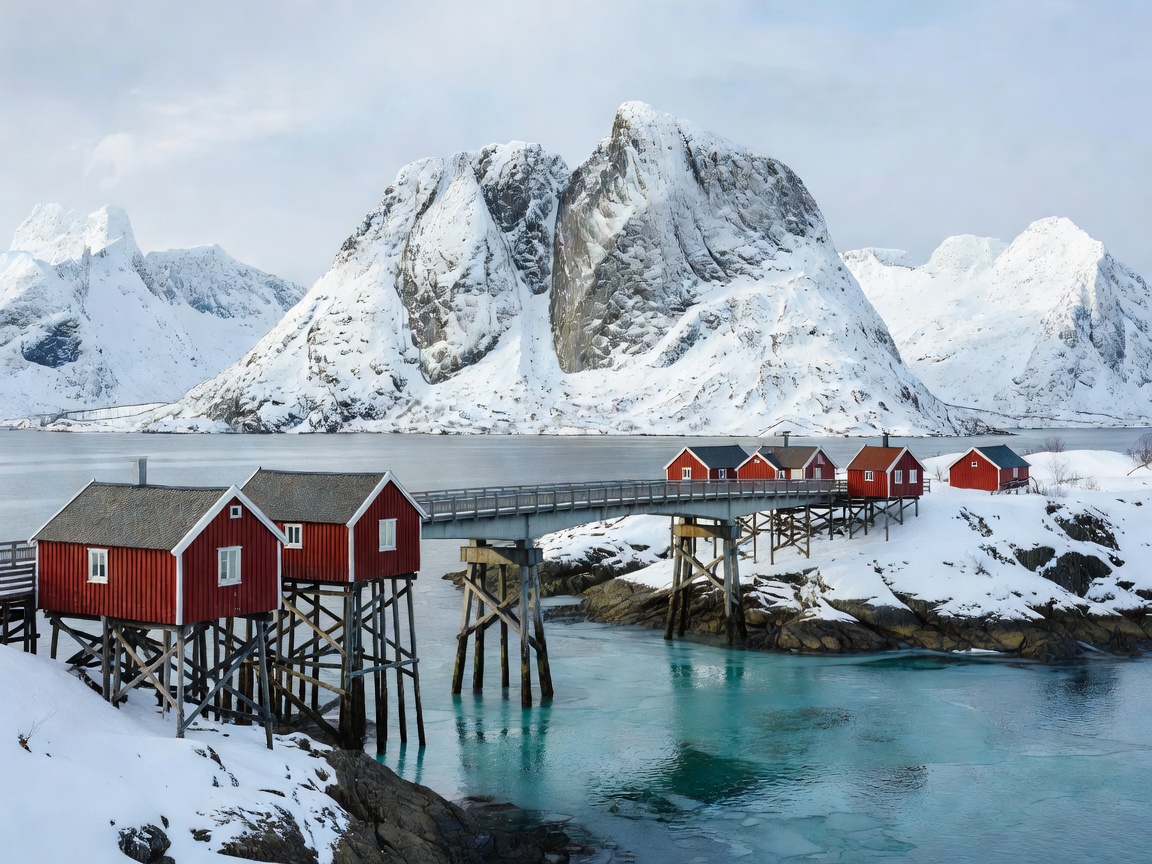
Situated inside the Arctic Circle off Norway’s northwestern coast, the Lofoten archipelago combines razor-sharp granite mountain peaks rising directly from the Norwegian Sea with historic fishing culture. In winter, the low solar trajectory creates perpetual golden hours that last for 4 to 5 hours daily, followed by potential green Aurora curtains across the night sky.
1. Hamnøy Bridge Vantage (The Red Cabins)
The bridge connecting Hamnøy to Toppøya (GPS: 67.9455° N, 13.1311° E) is arguably the single most recognized photography location in northern Europe.
- Composition: Position your camera on the pedestrian sidewalk on the southern side of the bridge. Use a 24mm to 35mm focal length to frame the cluster of red Eliassen Rorbuer cabins on the rocky outcrop in the lower third, with the colossal Festhelltinden mountain occupying the background.
- Long Exposure Water Smoothing: Use a 6-Stop ND filter to extend exposure time to 15-30 seconds, transforming choppy oceanic surf into an ethereal silky mist while preserving crisp detail on the cabins.
Arctic sea spray freezes instantly on optical elements. Keep lens hoods attached at all times, carry multiple microfiber cloths inside warm inner jacket pockets, and never blow breath onto cold glass to clean dust, as condensation will immediately freeze into an opaque ice sheet.
2. Reinebringen Summit (Sherpa Steps)
Rising 448 meters directly over Reine fjord, Reinebringen offers a 360-degree aerial panorama over the islands, bridges, and sea channels.
The ascent is via 1,560 stone Sherpa steps. In winter, micro-spikes/crampons and trekking poles are mandatory as the upper section is prone to sheet ice. The view at sunset looking south over the Reine archipelago is unexcelled in landscape photography.
3. Dialing in Aurora Borealis Exposures
When KP index forecasts show geomagnetic activity and skies are clear, coastal locations like Uttakleiv Beach and Skagsanden Beach provide dark sky horizons with dramatic tidal reflections.
- Aperture: Maximum wide open (f/1.4 to f/2.8).
- ISO Setting: ISO 1600 to 3200 depending on moon brightness.
- Shutter Speed: Keep between 2s and 6s for fast-dancing dynamic aurora ribbons. Exposures longer than 10 seconds will blur sharp atmospheric curtains into an indistinct green wash.