The Continental Golden Hour & Twilight Almanac
Precision astronomical timings, atmospheric diffusion factors, and exposure calibrations for Europe’s most storied panoramic view corridors.
The Physics of European Golden Light
Due to Europe’s latitude (ranging from 36° N in Andalusia and Greece to 71° N in northern Scandinavia), the velocity at which the sun crosses the horizon changes drastically. While Mediterranean locations enjoy a rapid 25-minute transition through civil and nautical twilight, high-latitude destinations like Scotland and Norway experience prolonged golden hours where the sun skims the horizon for hours, providing extended low-angle directional illumination.
Lighting Almanac & Vantage Index
| Location | Optimal Phase | Ideal Azimuth | Recommended Lens | Key Exposure Note |
|---|---|---|---|---|
| Piazzale Michelangelo (Florence) | Sunset / Blue Hour | 292° WNW | 70-200mm | Bracket 3 exposures (-2, 0, +2 EV) for city street lamps |
| Lake Stellisee (Zermatt) | Sunrise (Alpenglow) | 062° ENE | 16-35mm | Arrive 40 mins prior to sunrise before wind disturbs reflection |
| Ojstrica Peak (Lake Bled) | Sunrise | 074° ENE | 24-70mm | Use soft grad ND to balance bright mountain backdrop |
| Bermondsey Wall (London) | Sunrise | 068° ENE | 24mm Prime | Low tide reveals wet pebbles for rich foreground reflections |
| Miradouro da Senhora do Monte (Lisbon) | Sunset | 275° W | 35mm / 50mm | Warm terracotta rooftops reflect golden sunlight across the Tagus |
| Charles Bridge (Prague) | Dawn Blue Hour | 082° E | 24-70mm | Shoot between 05:00 - 05:45 to avoid crowds and catch gas lanterns |
The Arno Terraces & Tuscan Sunset Glow
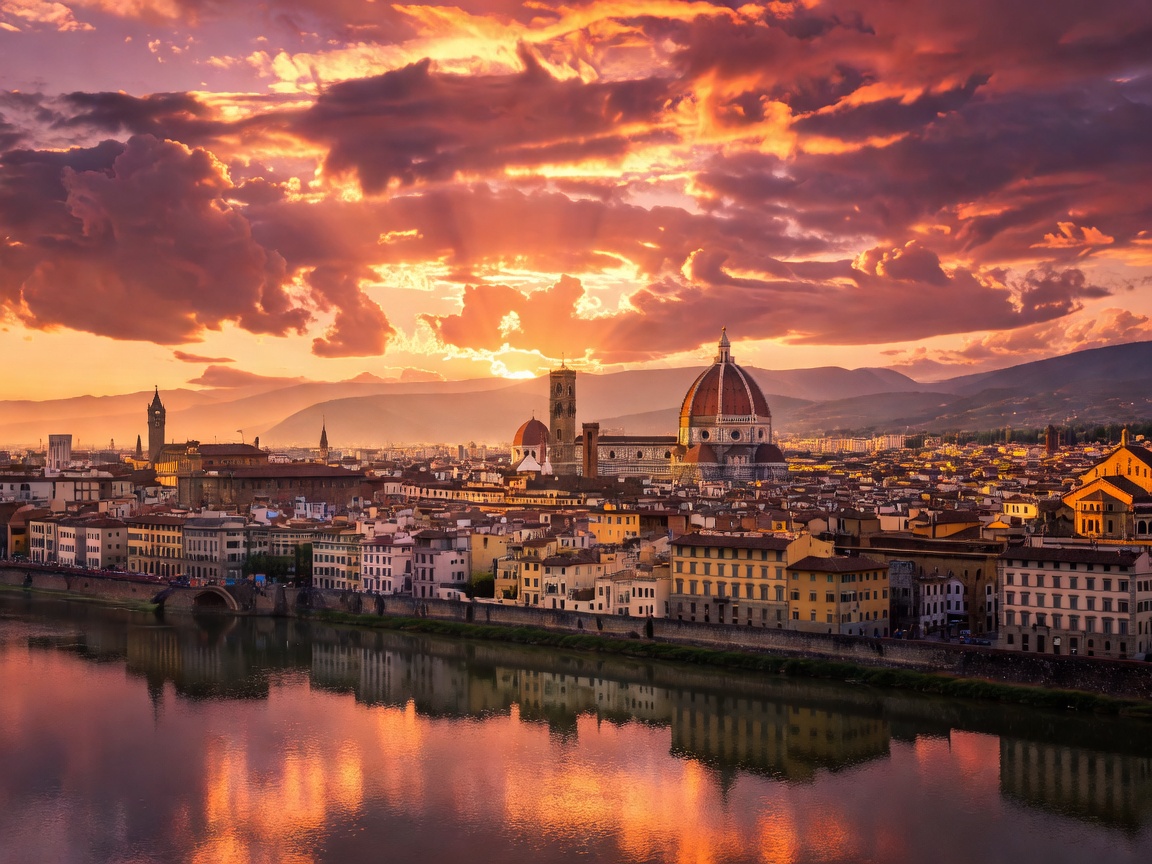
Perched on the southern hillside overlooking Florence, Piazzale Michelangelo (43.7630° N, 11.2650° E) offers the quintessential panorama over the historic Arno River, the arches of the Ponte Vecchio, and Brunelleschi's iconic Duomo dome.
- Sun Azimuth (292° WNW): In late spring and autumn, the setting sun aligns directly down the Arno valley corridor, illuminating river water in molten gold while silhouetting the bridges.
- Camera Calibration: Set your focal length to 70-135mm on a full-frame sensor. Shoot at f/8 to f/11 at base ISO 64/100. Use a 3-stop hard neutral density graduated filter aligned with the Tuscan hill ridgeline to prevent blown sky highlights.
- Blue Hour Transition: Stay for 35 minutes after sunset. As the sky deepens to indigo, the sodium floodlights on Santa Maria del Fiore and Palazzo Vecchio create rich warm-and-cool complementary color harmony.
London Tower Bridge Dawn Inversion
The southern foreshore of the River Thames near Bermondsey Wall & Butler's Wharf (51.5033° N, 0.0734° W) provides exceptional foreground geometry during low tide at dawn.
- Sunrise Alignment (068° ENE): The morning sun rises directly behind the twin Victorian neo-Gothic suspension towers, backlighting the steel cables and stone stonework with pastel magenta and amber gradients.
- Low Tide Foreshore Technique: Check the Port of London Authority tide tables. Low tide exposes wet river shingle and tidal puddles, allowing mirror-like low-angle compositions reflecting the illuminated towers.
- Exposure Recipe: 24-70mm lens at 28mm, aperture f/11, shutter speed 2.5 seconds (with 3-stop ND filter) to smooth water eddies into a glass texture.
Lake Stellisee & Matterhorn Pyramid Sunrise
Situated at an elevation of 2,537 meters in the Swiss Valais Alps, Lake Stellisee (45.9765° N, 7.7491° E) is world-renowned for its pristine, crystal-clear reflection of the Matterhorn's iconic 4,478m pyramid peak.
- Timing & Micro-Climate: Arrive at the lake bank 40 minutes prior to official sunrise. The first sunlight illuminates only the uppermost tip of the eastern Matterhorn ridge in fire-red alpenglow before washing down the sheer rock face.
- Wind Window: The lake is dead calm during the 20 minutes immediately following astronomical dawn. Thermal valley breezes typically begin around 07:15 AM, creating ripples that destroy the mirror surface.
- Optical Setup: 16-35mm f/2.8 ultra-wide lens, Circular Polarizer tuned carefully to maximize underwater stone visibility in the foreground without darkening the alpine sky unevenly.
Ojstrica Viewpoint, Lake Bled Morning Fog
The rocky precipice of Ojstrica (46.3636° N, 14.0938° E) sits 611 meters high above the western shoreline of Lake Bled, commanding an elevated view of the Assumption of Mary pilgrimage church on the island below with Bled Castle perched on distant cliffs.
- Seasonal Peak (Autumn Inversions): In October and November, cold air drainage from the Julian Alps meets the warmer lake water, generating rolling layers of morning mist that wrap the church in dramatic ethereal veils.
- Trail Navigation: 25-minute steep scramble from Camp Zaka along Trail 6. Headlamp and sturdy footwear with vibram lug soles are mandatory on dew-covered limestone rocks.
- Recommended Focal Length: 24-105mm at 50-70mm to frame both the island church and the jagged Karavanke mountain range backdrop in sharp focus at f/9.
Exposure Formulas for Twilight Scenes
When shooting high-contrast city skylines during nautical twilight (when artificial city lights match the residual ambient blue sky intensity), follow this baseline calibration:
- Base ISO: Lock to ISO 64 or 100 to maximize sensor dynamic range and prevent shadow noise in underexposed water bodies.
- Aperture Selection: Choose f/8 to f/11. This ensures full depth of field from immediate foreground elements to distant horizons while staying within the optical sweet spot before diffraction softens the image.
- White Balance Setting: Set manually to 4500K - 5200K. Leaving white balance on "Auto" will cause the camera sensor to neutralize rich blue hour hues and warm amber incandescent fixtures.